
Understanding Toll Manufacturing/Arrangement

Introduction to Manufacturing Methods
Manufacturers have various options when it comes to producing their finished goods. They can opt for:
In-house manufacturing (ie the manufacturer does the manufacturing process itself).
Contract manufacturing (the manufacturer outsources certain manufacturing processes to a third party).
Toll manufacturing arrangements.
In this blog, we discuss the toll manufacturing process.
In manufacturing, a tolling arrangement refers to a deal where a company (the principal or brand owner) provides raw materials (or key inputs) to a third-party manufacturer (the toller) who then processes or manufactures the final product on behalf of the company, usually for a fixed fee or ‘toll’. The ownership of the raw materials and finished goods typically stays with the company, not the manufacturer.
What is Toll Manufacturing?
Tolling Arrangement (aka toll manufacturing):
The brand owner supplies the raw materials or active ingredients.
The toll manufacturer provides the facility, labour, machinery, and process.
The toller charges a processing fee per unit, batch, or time.
No transfer of ownership of the materials or product occurs at any point (it remains with the brand owner).
Example: A pharmaceutical company provides active ingredients to a third-party plant, which processes and packages the tablets according to the company’s specifications.
Hard vs Soft Tolling
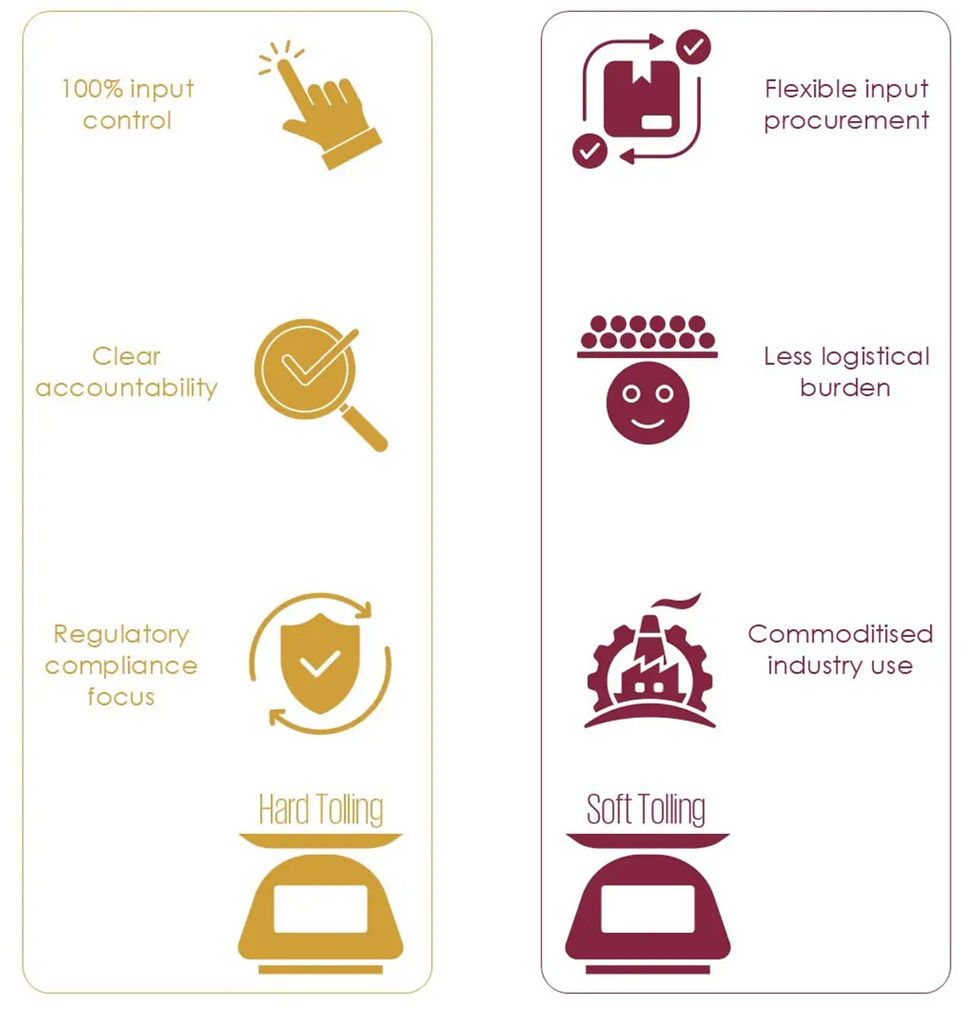
Hard Tolling
Brand owner provides 100% of inputs.
Toller is strictly a processor.
Clear accountability and traceability.
Used where regulatory or quality control is critical.
Soft Tolling
Brand owner allows toller to procure inputs, but ownership and specifications are usually tightly controlled.
More flexible, less logistical burden for brand owner.
Toll manufacturer has flexibility to determine the inputs and source suppliers.
Common in less regulated or more commoditised industries.
Feature | Hard Tolling | Soft Tolling |
Ownership of inputs | Brand owner supplies all raw materials. | Toller sources raw materials, but ownership remains with brand owner. |
Material sourcing | Supplied entirely by brand owner. | Toller may procure some or all materials. |
Risk of inventory | Brand owner carries the inventory risk. | Still on the brand owner, but more blurred. |
Control | High control by brand owner. | Some sourcing decisions delegated to toller. |
Example | Brand sends 10 tons of resin to toller. | Toller buys resin on brand’s behalf, processes it. |
Summary of Hard vs Soft Tolling
Tolling vs Contract Manufacturing
Feature | Tolling | Contract Manufacturing |
Material ownership | Stays with brand owner | Often provided by CMO |
Payment basis | Fixed fee for processing | Usually cost-plus or per unit |
Inventory risk | Brand owner | CMO (or mixed) |
Benefits of Toll Manufacturing for Brand Owners
Opting for a tolling arrangement can offer brand owners several advantages. It allows them to leverage the expertise and resources of specialised manufacturers without the need for significant capital investment in production facilities. Additionally, toll manufacturing can provide flexibility in scaling production up or down based on demand fluctuations, enabling brand owners to focus on core competencies such as product development and marketing while leaving the manufacturing process to experienced partners.
Risks of Toll Manufacturing
While toll manufacturing offers benefits, there are risks involved:
Brand owners may face challenges such as limited control over the manufacturing process.
Potential quality inconsistencies.
Dependency on the toller's capabilities and capacity.
Risk of intellectual property leakage. Intellectual property risk is a particular concern as the toller gains significant insights and knowledge on the specifications to manufacture the products and could produce competing products.
Fluctuations in tolling fees or unexpected changes in the toller's business could impact production costs and timelines for the brand owner.
How To Mitigate The Risks of Toll Manufacturing
Establish clear contractual agreements outlining intellectual property rights and confidentiality measures.
Regularly monitor and audit the toller's processes to ensure quality standards are met.
Diversify suppliers or have contingency plans in place to mitigate dependency risks.
Implement robust quality control measures and performance metrics to track the toller's capabilities.
Stay informed about the toller's business operations and maintain open communication to address any potential changes or issues proactively.
Challenge the toller on any potential breaches and involve internal or external legal advisors in case of material breaches that cannot be resolved amicably.
For other information on other types of contracts used by manufacturers, see our post What is the difference between EPC and EPCM.
The information provided is for information purposes and does not constitute legal advice. Contact a lawyer should you require assistance. Legal Dynamix is not a law firm and does not provide legal advice on the subject matter contained herein.


Comments